
Is Custom Vinyl Lettering Worth It? A 2026 Review

Table of Contents
- What Custom Vinyl Lettering Actually Costs
- How Long Do Vinyl Car Decals Last?
- Custom Vinyl Decals for Recreational Gear
- How to Apply Custom Vinyl Lettering
- Vinyl Lettering vs. Full Vehicle Wraps
- Maintenance and Cleaning Best Practices
- The Verdict: When Custom Vinyl Lettering Is Worth It
- Frequently Asked Questions
Last Updated: September 21, 2026
What Custom Vinyl Lettering Actually Costs
The short answer: custom vinyl lettering is worth it when you need affordable, high-impact branding that lasts for years. The catch is knowing what you're actually paying for.
Custom vinyl lettering is precision-cut adhesive vinyl shaped into text, logos, or graphics, then applied to a smooth surface without a printed background. Because there's no background film, the lettering looks painted on rather than stuck on.
Cost depends on size, material, and how much design work you need.
Price Breakdown by Product Type
A personalized windshield text decal runs $18.95, sized up to 5 inches tall and 54 inches long. Fixed windshield banners like a Camaro, Denali, or Honda decal cost $29.99 for a 4-inch by 40-inch strip. All orders arrive weeded and masked, so the transfer tape is already in place.
| Product Type | Price | Size | Best For |
|---|---|---|---|
| Personalized text decal | $18.95 | Up to 5" x 54" | Custom business names, boats |
| Fixed windshield banner | $29.99 | 4" x 40" | Truck and muscle car windshields |
Compare that to a full wrap. For most people, lettering delivers the visual impact at a fraction of the cost.

How Long Do Vinyl Car Decals Last?
Most quality vinyl car decals last 5+ years outdoors when applied to a clean, smooth surface. Let's Print Big decals offer up to 5+ years outdoor life, and lamination extends that to 7+ years without fading.
That range assumes you did the prep work. A decal slapped onto a dusty panel will fail long before one applied to a properly cleaned substrate.
Factors That Shorten or Extend Lifespan
Sun exposure is the biggest variable. UV rays break down adhesive and fade pigment over time, which is why lamination matters in hot, sunny climates. Surface prep comes second: oil, wax, and dust all weaken long-term adhesion. Washing matters too. Abrasive brushes and harsh solvents chew through vinyl edges fast.
- Extends life: lamination, shade parking, hand washing, smooth substrate
- Shortens life: direct sun, textured surfaces, automatic car washes, extreme heat cycling
Custom Vinyl Decals for Recreational Gear
Recreational gear is where vinyl lettering quietly outperforms almost everything else. Cornhole boards, coolers, kayaks, boat hulls, and tailgate setups all take decals well because their surfaces are smooth and flat.
The same precision-cut vinyl that works on a windshield sticks to any smooth surface indoors and out. That flexibility is why cornhole players and backyard game hobbyists order personalized text decals rather than buying pre-printed boards. You pick the wording, the font, and the color, and the decal arrives masked and ready.
For patriotic graphics or family names, a $18.95 personalized decal covers it. No minimum order, no template lock-in.
How to Apply Custom Vinyl Lettering
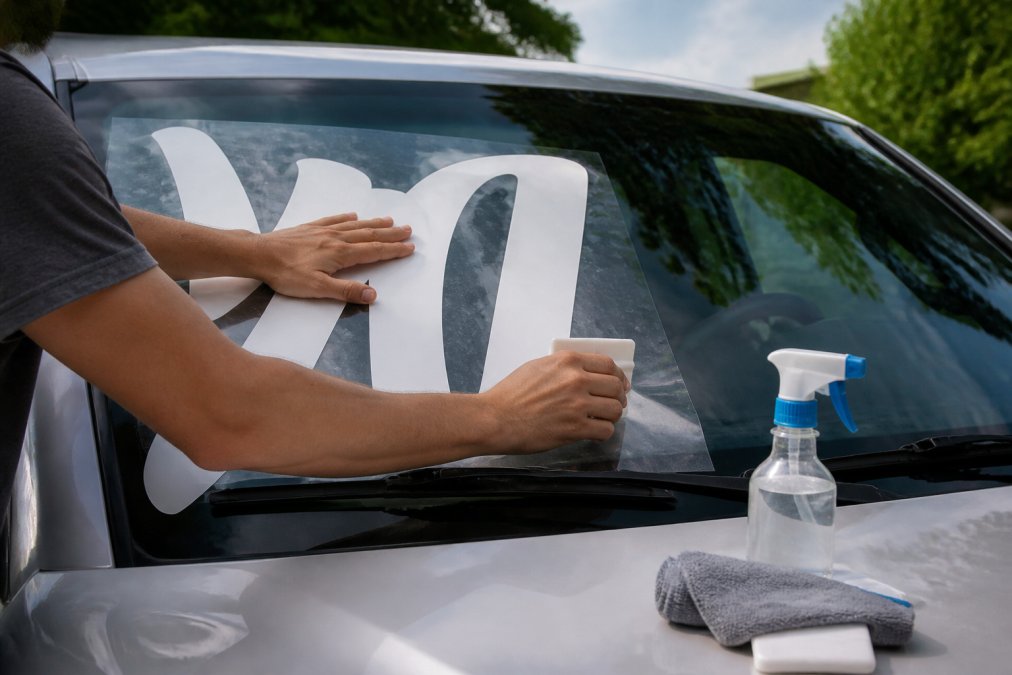
Applying custom vinyl lettering takes about 15 minutes on a clean surface. The process is the same whether you're working on a windshield, a cornhole board, or a boat.
Step-by-Step Installation
- Clean the surface. Wipe with isopropyl alcohol and let it dry fully.
- Position the decal. Tape the top edge in place and step back to check alignment.
- Peel the backing. The transfer tape holds the letters in position.
- Apply from the center out. Use a squeegee to push air toward the edges.
- Remove the transfer tape. Pull it back at a sharp angle, slowly.
- Burnish the edges. Press firmly along every letter edge for adhesion.
Vinyl Lettering vs. Full Vehicle Wraps
The two products are not really competitors, they solve different problems. Lettering is a cut-vinyl product: the vinyl is shaped into text or graphics and applied with no background film, so the surface shows through. A wrap is a printed vinyl film that covers entire panels, usually with a laminate layer on top.
Personalized Windshield Text Lettering →
Where Lettering Wins
- Cost. A personalized text decal runs $18.95, and a fixed windshield banner runs $29.99. A full wrap typically requires far more material, print time, and installation labor.
- Flexibility. You can letter one windshield, one door, or one cornhole board. A wrap commits you to a full panel or the whole vehicle.
- Reversibility. Removable-adhesive lettering peels off cleanly, which matters for leased vehicles and seasonal branding.
- Installation. Most lettering jobs are a 15-minute DIY project. Wraps generally require a professional installer and a controlled environment.
Where Wraps Win
- Coverage. A wrap changes the entire color of a vehicle or hides damaged paint. Lettering cannot do either.
- Complex graphics. Full-color photographic imagery, gradients, and edge-to-edge designs belong on a wrap, not on cut vinyl.
- Paint protection. A wrap acts as a sacrificial layer over the paint underneath.
The Vinyl Type Question Most Buyers Miss
Before you choose lettering over a wrap, know which vinyl you are buying. The two main families behave very differently outdoors:

- Monomeric vinyl is a thinner, less expensive film. It is fine for flat surfaces and short-to-medium outdoor life, but it does not like curves and tends to shrink over time.
- Polymeric vinyl is a thicker, more dimensionally stable film. It conforms to curves and rivets, resists shrinkage, and is the right choice for anything that lives outdoors for years.
Adhesive matters too. Permanent adhesive is the default for vehicle and outdoor applications, it grips hard and is meant to stay. Removable adhesive peels cleanly for wall graphics, temporary promotions, and leased surfaces. Choosing the wrong adhesive is the most common reason a decal either falls off early or takes paint with it on removal.
How to Decide
Choose lettering if you want business information, a vehicle name, or a logo on a specific area, and you want it applied in minutes for a fraction of the cost. Choose a wrap if you want to change the entire color of the vehicle, cover damaged paint, or run full-color photographic graphics. For most enthusiasts and small operators, lettering delivers the branding and visual impact without the wrap-sized commitment.
Maintenance and Cleaning Best Practices
Most vinyl lettering does not fail because the material was bad. It fails because of how it was cleaned. The right routine depends on what the lettering is stuck to and what vinyl type you bought.
The Universal Rules
- Hand wash whenever possible. A soft mitt or microfiber cloth with mild soap and water is the safest method on any surface.
- Skip automatic brush car washes. The spinning brushes catch decal edges and peel them back a little more on every pass.
- Never aim a pressure washer directly at the edges. A fan tip held at an angle and at least a foot away is fine; a concentrated stream at the edge will lift the film.
- Avoid harsh solvents. Gasoline, acetone, and strong degreasers break down adhesive and dull the vinyl face.
- Rinse before you wipe. Loose grit dragged across the surface acts like sandpaper on the vinyl.
Surface-Specific Guidance
Vehicle windshields and painted panels. Wash top-down with mild soap, rinse thoroughly, and dry with a microfiber towel. Bug and tar removers are safe on the vinyl face but should be rinsed promptly, do not let them dwell on the edges.
Glass windows and storefronts. Glass cleaners are fine on the glass, but spray the cloth, not the decal, so cleaner does not pool under the edges.
How Often, and What to Watch For
A quick rinse every couple of weeks and a full hand wash monthly is enough for most outdoor lettering. Inspect the edges each time. If you see a corner starting to lift, press it back down with a clean squeegee while the surface is dry, catching it early prevents the whole letter from peeling.
The Verdict: When Custom Vinyl Lettering Is Worth It
Custom vinyl lettering is worth it when you want professional appearance, personalization, and durability without a wrap-sized budget. It's not worth it if your surface is rough, heavily textured, or damaged. Vinyl needs a smooth substrate to bond properly.
Frequently Asked Questions
How much does custom vinyl lettering cost?
Pricing depends on size, material, and complexity. At Let's Print Big, personalized windshield text lettering starts at $18.95, while pre-designed windshield decals like the Camaro or Honda styles are $29.99. These prices reflect precision-cut, weather-resistant vinyl that is masked and ready to apply. Larger orders and custom designs may have different pricing, so it is best to request a quote for your specific project.
How long do vinyl car decals last?
With proper care, high-quality vinyl car decals last up to five years outdoors. Adding lamination can extend that to seven or more years without fading. Factors like sun exposure, surface preparation, and cleaning habits affect longevity. Decals applied to smooth, clean surfaces and kept out of harsh conditions will hold up longer. Let's Print Big's decals are designed for outdoor use and resist weather damage.
Can custom vinyl lettering be applied to any surface?
Vinyl lettering sticks best to smooth, non-porous surfaces like glass, metal, and painted vehicle panels. It also works on cornhole boards, boats, and indoor walls. Rough or textured surfaces prevent proper adhesion, leading to peeling. Always clean the surface with isopropyl alcohol before applying.
Is vinyl lettering better than printed decals?
Vinyl lettering is cut from solid colored material, so there is no background film. This gives a cleaner, more professional look on windows and vehicles. Printed decals can reproduce full-color images but may fade faster. For text, logos, or simple graphics, vinyl lettering is more durable and cost-effective. For complex photos, printed decals are the better choice.
Do vinyl stickers peel off?
They can be removed intentionally with heat and a plastic scraper, but they will not peel off on their own if applied correctly. Proper surface preparation and a smooth application prevent edges from lifting. Outdoor vinyl is designed for long-term adhesion.