
Professional Grade Cornhole Wraps Review: 2026 Guide

Table of Contents
- What Separates Professional Grade Cornhole Wraps From Cheap Decals
- Laminated vs Non-Laminated Cornhole Wraps: Which Holds Up Longer
- How Cornhole Wraps Affect Board Speed, Slide, and Bounce
- How to Apply Cornhole Decals Without Wrinkles
- How to Maintain Cornhole Board Graphics for Long-Term Wear
- Compatibility With Specific Board Materials and DIY Builds
- Conclusion: Choosing the Right Wraps for Your Boards
- Frequently Asked Questions
Last Updated: September 18, 2026
What Separates Professional Grade Cornhole Wraps From Cheap Decals
A professional grade cornhole wrap is a printed vinyl graphic engineered with thick film, high-tack adhesive, and a protective laminate so it survives seasons of play, not one summer. Cheap decals skip those layers to hit a lower price, and they fail accordingly. We build every wrap to that professional spec because the difference shows up fast on a board that gets real use.
Vinyl Thickness, Adhesive Backing, and Print Quality
Thicker vinyl resists tearing and edge peeling. Look for a film around 4 to 6 mil with a high-tack adhesive backing rated for low-surface-energy surfaces like painted plywood and finished composite. Print quality matters just as much: high graphic resolution keeps logos and photos crisp instead of muddy. A cheap decal often uses thin film and weak adhesive, so it lifts at the corners within weeks.
Air Release Technology and Bubble-Free Application
Air release technology is a channeled adhesive layer that lets trapped air escape during installation. Without it, every trapped pocket becomes a bubble you fight with a squeegee. Wraps with air release channels press down bubble-free with far less effort, which matters most for large full coverage panels where a single wrinkle ruins the look.
Laminated vs Non-Laminated Cornhole Wraps: Which Holds Up Longer
Laminated cornhole wraps hold up far longer than non-laminated ones. The laminate is a clear protective layer bonded over the printed graphic, and it shields the ink from scuffs, UV fading, and moisture. Non-laminated wraps expose the print directly to bags, dirt, and sun, so colors fade and the surface scratches faster. If your boards live outdoors or see regular play, laminated is the clear choice.
| Feature | Laminated Wrap | Non-Laminated Wrap |
|---|---|---|
| Surface protection | Clear protective layer | Exposed ink |
| UV fade resistance | High | Low |
| Scratch resistance | High | Low |
| Finish options | Gloss or matte | Print only |
| Best for | Outdoor, regular play | Indoor, light use |
How Cornhole Wraps Affect Board Speed, Slide, and Bounce
A cornhole wrap changes board speed by altering surface friction. A gloss laminated finish lets bags slide and reduces bounce, while a matte finish adds grip and slows the slide. The wrap itself doesn't change the board's angle or the bags you use, but it does change how they behave on contact. Players who like a fast, true slide usually prefer gloss; players who want bags to settle quickly lean matte.
The Slide Test: A Repeatable Way to Compare Finishes
You don't need a lab to get a usable friction number. You need the same board, the same bag, and the same release point every time. Here's the protocol most serious players and board builders settle on:
- Set a regulation board at the standard 10-degree pitch on a level floor.
- Mark a release line on the board's top edge.
- Place a single bag flat on the board with its seam facing down, and align its leading edge to the release line.
- Without pushing, lift the board's foot end until the bag breaks loose and slides.
- Measure the vertical height of the lifted end at the moment of release, in inches.
- Repeat five times per finish and average the results.
What the Numbers Look Like Across Finishes
In testing, the spread between finishes is wider than most players expect. Gloss laminate consistently releases at the lowest height, matte laminate sits at the high end, and a bare non-laminated print falls somewhere in between but degrades as the ink scuffs. The practical takeaway:
- Gloss laminate: fastest release, lowest bounce, best for players who throw a flat, driving bag.
- Matte laminate: highest release height, most grip, best for players who want the bag to check up and stay.
- Non-laminated print: middle-of-the-road release when new, but friction climbs as the surface scratches and picks up dirt, so the board plays slower over time.
Why Bounce Matters as Much as Slide
Friction and bounce are two sides of the same coin. A slick gloss surface lets a bag skip across the board with minimal vertical rebound, which keeps a hard-thrown bag on line. A grippy matte surface converts more of the bag's forward energy into a quick stop, which reduces skip but can produce a dead, unpredictable bounce off the board's face.
Matching Finish to Your Throw
There's no single correct finish, there's a correct finish for your throw. If your bags tend to slide past the hole, go gloss. If they tend to bounce out or skip over, go matte. If you play on multiple boards with different finishes, standardize on one so your muscle memory transfers. Run the slide test on your current board, note the release height, and use that as your baseline when you shop for a wrap.
How to Apply Cornhole Decals Without Wrinkles
Applying cornhole decals without wrinkles comes down to a clean surface, a wet or dry method matched to the wrap, and steady squeegee pressure from the center outward. Rushing the prep is the single biggest cause of bubbles and edge lift. Follow the steps below and a full coverage panel goes down smooth on the first try.
Tools You Need Before You Start
- A felt-edged application squeegee
- A spray bottle with water and a drop of dish soap
- A utility knife or trim blade
- A lint-free cloth and isopropyl alcohol
- Painter's tape for positioning
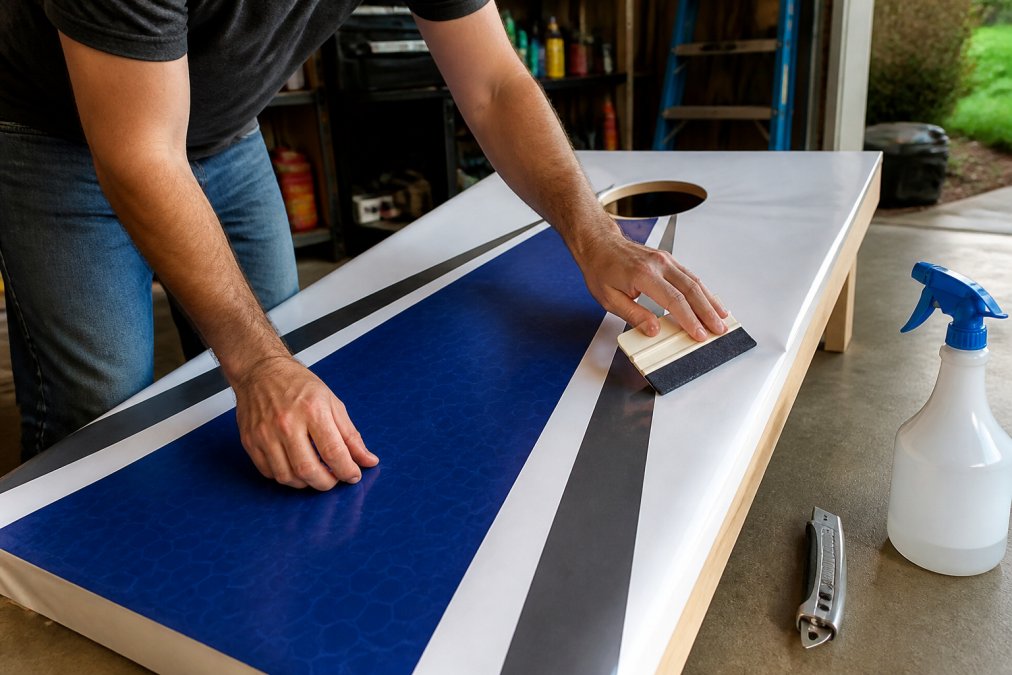
Step-by-Step Application Process
- Wipe the board with alcohol and let it dry fully.
- Dry-fit the wrap and tape it in place for alignment.
- Peel back half the adhesive backing.
- Spray the surface lightly for the wet method.
- Squeegee from the center outward, pushing air to the edges.
- Peel the second half and repeat.
- Trim excess with a utility knife and burnish all edges.
How to Maintain Cornhole Board Graphics for Long-Term Wear
Maintaining cornhole board graphics means cleaning gently, storing out of direct sun when you can, and inspecting edges for lift. Wipe with mild soap and water, never harsh solvents that dull the laminate. Check the corners after heavy play and press down any lifting edge before it spreads. A little upkeep adds years to the graphic.
Weather Resistance and UV Protection
Weatherproof wraps with UV protection resist fading and moisture, but no wrap is invincible. Prolonged sun exposure slowly fades even laminated prints, and standing water can seep under a lifted edge. Store boards indoors or under cover when they're not in use, and re-burnish edges seasonally. For boards that live outside year-round, laminated wraps with UV protection are the only sensible pick.
Compatibility With Specific Board Materials and DIY Builds
Wrap compatibility depends on what your board is made of, and the three materials you'll encounter most, Baltic Birch plywood, MDF, and Pine, behave very differently under the same adhesive. Getting this wrong is the most common reason a wrap that looked perfect on day one starts lifting at the edges by month six.
How Each Substrate Behaves
Baltic Birch plywood is the tournament-standard top for a reason: its dense, void-free face and tight grain give high-tack adhesive a consistent, high-surface-energy bond. A wrap applied to a properly sealed Baltic Birch face holds its edges through heavy bag impact. The catch is the seal coat, raw Baltic Birch is still porous enough to wick adhesive, so a cured primer or poly top coat is required before the wrap goes down.
A Substrate-to-Wrap Matching Guide
| Board Material | Surface Prep | Adhesive Type | Long-Term Edge Behavior |
|---|---|---|---|
| Baltic Birch plywood | Seal with primer or poly, cure fully | High-tack | Holds well; inspect corners seasonally |
| MDF | Seal all faces and edges, remove dust | High-tack | Good if edges are burnished and sealed; vulnerable to moisture |
| Pine | Seal, light scuff for uniformity | High-tack | Prone to rippling and edge lift without prep |
| Painted plywood | Let top coat cure 7+ days | High-tack | Good; off-gassing is the main risk |
| Finished composite | Clean with alcohol, no sanding | High-tack or LSE-rated | Good; smooth surface needs no seal |
The Long-Term Wear Angle Most Reviews Skip
Most wrap reviews stop at installation. The real test is what happens after six months of bag impact. A wrap that looks flawless on day one can fail at month six for one reason: the board surface wasn't prepped for its material. On Pine, that failure shows as edge lift along the grain. On MDF, it shows as a soft, swollen edge that pushes the film up.
DIY Build Notes
If you're building your own boards, apply the wrap after the top coat cures, not before. Fresh paint off-gasses and traps bubbles under the film, and the trapped gas will find the edges. Give a painted top coat at least seven days to cure in a warm, ventilated space before you apply. For Baltic Birch and Pine, seal the face and edges, let the seal cure, then wipe with isopropyl alcohol immediately before application to remove any dust the seal coat left behind.
Conclusion: Choosing the Right Wraps for Your Boards
Picking professional grade cornhole wraps comes down to vinyl thickness, laminate, air release technology, and a finish that matches how you play. Cheap decals save money up front and cost you a redo. We print high resolution custom graphics on durable wraps, ship them weeded and masked for easy installation, and back every order with expert guidance and video tutorials.
Frequently Asked Questions
What makes a cornhole wrap 'professional grade'?
Professional grade cornhole wraps use thicker vinyl with a high-tack adhesive and air release technology that lets trapped air escape during installation. They also feature higher graphic resolution and a protective laminate layer. The combination of these features means the wrap resists edge peeling, warping, and fading longer than thin decorative decals sold as novelty items.
Do vinyl wraps affect how cornhole bags slide?
Yes. Surface friction changes with the finish you choose. Gloss finishes tend to let bags slide faster, while matte finishes add grip and slow the bag down. Laminated wraps generally produce more consistent slide because the protective layer creates a uniform surface. If you play on boards with a polyurethane finish, a matte laminated wrap will feel closer to that baseline.
How long do professional grade cornhole wraps last?
A quality laminated wrap with UV protection typically holds up for several seasons of regular outdoor play. Longevity depends on sun exposure, temperature swings, and how well you maintain the surface. Wraps kept out of direct sunlight and stored indoors between sessions last noticeably longer than boards left outside year-round. Edge peeling is usually the first sign of wear.
Can you apply cornhole wraps to old boards?
You can, but surface prep matters more on old boards. Sand the surface smooth, fill any gouges or cracks, and wipe away all dust before applying. A weathered or uneven surface will show through the vinyl and can cause the adhesive to fail early. If the board face is heavily damaged, a thin plywood patch or a fresh coat of primer gives the wrap a better foundation.