
How to Measure a Truck Bed for Decals

Last Updated: November 8, 2026
Quick Summary
To measure a truck bed for decals, record the interior length from the front bulkhead to the inside edge of the tailgate, the flat bedside panel height, and the narrowest width between the wheel wells, all in inches. These three numbers let a print shop scale truck bed decals to fit your exact panel.
- Measure bed length along the floor from the front bulkhead to the inside edge of the tailgate.
- Write every measurement in inches with fractions, rounding to the nearest quarter inch.
- Measure the bedside panel from the top rail down to the wheel arch at its tallest clear point.
- Plan at least 1 inch of margin on every side of the decal.
- Match the decal to your smallest measurement, not your largest, to avoid overhang.
Table of Contents
- Why Accurate Truck Bed Measurements Matter for Truck Bed Decals
- Tools You Need Before You Measure
- How to Measure a Truck Bed Length
- How to Measure Truck Bed for Decals in Inches
- How to Find Truck Bed Size by VIN
- How to Measure Truck Bed for Decals on a Chevy Silverado
- Choosing Decal Size and Placement for Your Measurements
- Ordering Custom Truck Bed Decals That Match Your Numbers
- Frequently Asked Questions
Why Accurate Truck Bed Measurements Matter for Truck Bed Decals
A tape measure and five minutes save you from a costly reorder. That is the short answer to why measurements matter so much for truck bed decals. Get the length or panel height wrong by even a couple of inches, and a graphic that looked perfect online will either hang over an edge or leave an awkward gap. A common mistake is ordering by memory instead of by tape.
Here is the good news. Measuring a bed is simple once you know which numbers count. You need the interior length, the flat height of the bedside panel, and the space between the wheel wells. Below, we walk through each measurement step by step, plus how to double-check your numbers before you order.
Most guides skip the details that trip people up. Wheel wells, bed liners, and defroster lines all change what "flat" really means. We cover those too.
Tools You Need Before You Measure
Gather your tools first so you only climb into the bed once. A retractable steel tape measure is the only must-have. A helper makes longer measurements easier, but you can manage alone with a tape that locks.
Here is what we recommend having on hand:
- A tape measure at least 8 feet long
- A pencil and notepad, or your phone's notes app
- Painter's tape to mark reference points
- A level or straight edge for checking flat panels
- A soft cloth to wipe down dusty surfaces
Skip cloth measuring tapes. They stretch, and a stretched tape gives you a wrong number. Steel blades hold their length.
Watch out: measuring on a sloped driveway can throw off your reading. Park on level ground before you start.
How to Measure a Truck Bed Length
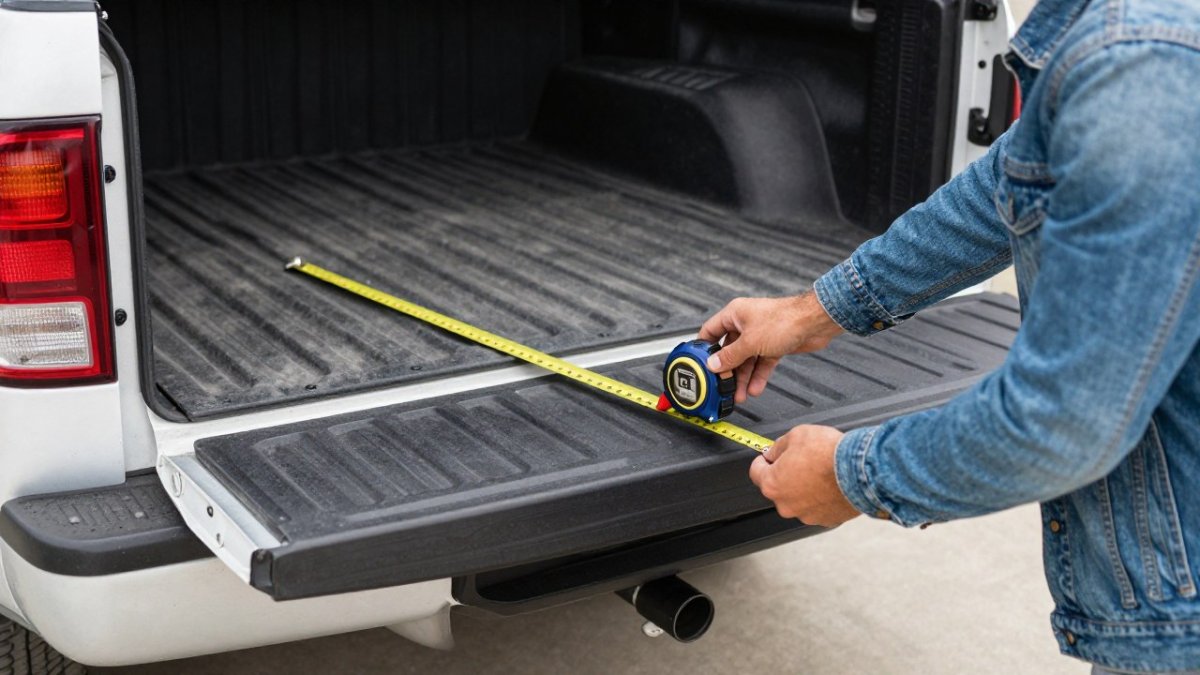
Truck bed length is the distance from the front bulkhead to the inside edge of the tailgate, measured along the floor. Lower the tailgate and hook your tape at the bulkhead. Pull it straight back to the tailgate lip. Read the number where the tape meets the edge, not where the tailgate hinge sits.
The man is American.
Most full-size beds land in one of three groups: short, standard, and long. Short beds suit crew cabs. Standard beds fit extended cabs. Long beds show up on work trucks. Your exact number matters more than the label, though, because trim packages shift the figure by a few inches.
Accounting for Wheel Wells and Bed Liners
Wheel wells eat into the usable floor width, so measure the narrowest point between them. That gap is your true width for any graphic that spans the floor. A spray-in liner adds a thin layer to every surface, so measure on top of it, not under it.
Drop-in plastic liners create a bigger problem. Their ribs and channels mean the surface is not flat. A decal pressed over a rib will lift at the edges. Measure the flat sections between ribs, and plan your graphic around them.
Bed length is measured along the floor from the front bulkhead to the inside edge of the tailgate, and most full-size beds fall into three groups.
| Bed type | Typically found on | Note |
|---|---|---|
| Short bed | Crew cabs | Exact number matters more than the label |
| Standard bed | Extended cabs | Trim packages shift the figure by a few inches |
| Long bed | Work trucks | Measure yours rather than trusting a spec sheet |
How to Measure Truck Bed for Decals in Inches
Learning how to measure truck bed for decals in inches keeps your order simple, because most decal shops price and print by the inch. Write every number in inches with fractions, like 78 1/2 inches, rather than feet and inches. One unit means no conversion mistakes at checkout.
Round to the nearest quarter inch. Anything finer will not change how the decal fits.
Measuring the Flat Bedside Panel
The bedside panel is where most truck bed decals actually go, so measure its flat area carefully. Start below the top rail and stop above the wheel well arch. Measure the height at the tallest clear point.
Then measure the length of the flat run. Skip door seams, handles, and any curve that bends away from the panel. A decal needs a flat surface to bond well.
- Height: from the top rail down to the wheel arch
- Length: the longest straight run without seams
- Clearance: at least 1 inch of margin on every side
That margin gives you room to align the graphic without fighting an edge.
How to Find Truck Bed Size by VIN
Truck bed size by VIN is possible, but only with a decoder that reads build data, not a basic free lookup. A VIN identifies the truck's model, cab, and drivetrain. Bed length is tied to those build codes, so a full decoder can confirm your tape measurement. A free VIN check usually shows model and year only.
Use the VIN as a backup, not a replacement. Tape measurements tell you what is actually on your truck today, including any aftermarket changes. A previous owner may have swapped beds or added a liner. The VIN cannot know that.
For a second opinion, check the NHTSA VIN decoder to confirm your truck's basic build details before you order.
How to Measure Truck Bed for Decals on a Chevy Silverado
Silverado beds come in several lengths, and the trim level changes the number, so measure yours rather than trusting a spec sheet. Run the tape from bulkhead to tailgate as described above. Then check the bedside panel height, since Silverado bedsides vary between trims.
Measure along the bed floor, not the top of the tailgate, since the two surfaces can sit at different heights.
Write down all three numbers: length, panel height, and width between wheel wells. Those three figures cover nearly every decal layout.
What the Trim and Cab Change
Bed length can vary with cab configuration, so the only reliable number is the one on your tape. Trim features such as moldings and bed rails can change where the flat panel ends, so measure to the visible edge of any molding.
Model-Year Quirks That Shift the Tape
If your truck has a liner or a segmented tailgate, measure the flat area that the graphic will actually cover, and note your model year and tailgate type on your order so the print shop can scale the art to fit. Matching the decal to the measured space also means accounting for how a cover will sit over the bed, so choosing a tonneau cover that fits your truck is part of planning a clean, unobstructed layout.
A Silverado-Specific Measurement Checklist
- Length: bulkhead to the inside edge of the tailgate, measured on the floor
- Bedside panel height: top rail down to the wheel-arch molding, at the tallest clear point
- Width: narrowest gap between the wheel wells, measured on top of any liner
- Tailgate: flat center section width and height, if the design goes on the gate
- Obstacles: liner type, bed rails, tie-down tracks, and any factory step
If your design reaches the rear glass, leave clearance around defroster lines and sensors before you finalize the size.
Choosing Decal Size and Placement for Your Measurements
Match the decal to your smallest number, not your largest. If your flat panel run is 60 inches, a 58-inch graphic leaves a clean margin. A 62-inch graphic will overhang and peel. This one rule prevents most sizing errors.
Think about placement before you buy:
- Bedside panels suit wide, horizontal designs
- Tailgates work well for square or centered graphics
- Front bulkheads stay protected but are rarely seen
Once you have your measurements, deciding on style and placement gets easier. Our guide on custom truck hood decals for off-roading walks through decal styles and placement choices that apply to truck graphics too.
Check state rules on window and side graphics if your design covers glass. The American Association of Motor Vehicle Administrators tracks how states handle vehicle marking rules.
Ordering Custom Truck Bed Decals That Match Your Numbers
Order with your three measurements written down, and add a note about any wheel wells or liner ribs. A print shop can then scale the art to fit your exact panel. At Let's Print Big, every graphic arrives weeded and masked, so the transfer tape is already in place when it reaches you.
Our decals use high-resolution printing for bold color. Installation guidance and video tutorials are included, and free shipping applies on qualifying orders.
A quick checklist before you check out:
- Length from bulkhead to tailgate recorded in inches
- Bedside panel height measured at the tallest clear point
- Width between wheel wells noted
- Liner type and rib spacing described
- At least 1 inch of margin planned on all sides
Get your tape, write the numbers down, and order with confidence from Let's Print Big.
A wrong measurement is the most common reason a custom graphic does not fit. Grab a steel tape, measure twice, and write each figure in inches. Let's Print Big makes the rest easy with high-resolution graphics, pre-masked decals that arrive ready to apply, and step-by-step installation videos. Get started with Let's Print Big and order a decal sized to your truck, not a guess.
Frequently Asked Questions
Should you measure the truck bed or the flat bedside panel for a decal?
Measure the flat bedside panel if your decal goes on the exterior side of the truck. The interior bed dimensions tell you cargo space, not the flat area a decal sticks to. Run your tape along the flat panel between the wheel arch and the cab, then between the wheel arch and the taillight, and note the tallest point above the wheel well. Give yourself at least 1 to 2 inches of margin on every side so the vinyl does not wrap over a curve or body line.
Can you tell truck bed length by VIN number?
A VIN can help identify the model and build details, but it may not confirm your exact bed length. Use the VIN to confirm the configuration, then measure the truck yourself before ordering truck bed decals. VIN data tells you the factory spec, but a bed liner, cap, or aftermarket panel can change the actual flat surface you have to work with.
How much space should you leave around a truck bed decal?
Leave at least 1 to 2 inches between the decal edge and any body line, wheel arch, or panel gap. That margin keeps the vinyl on a flat surface, makes squeegee work easier, and prevents edges from lifting when the panel flexes. On a rear window or tailgate, stay clear of defroster lines and hinges by the same margin. Measure the flat area first, subtract the margins, and order a decal that fits inside that footprint.
What size are truck decals typically ordered in?
Truck bed decals are ordered in inches, and the right size depends on your measurement. The right size depends on your measurement, not a standard. Measure the flat panel in inches, subtract your margins, and order to that number. If you are unsure, size down slightly rather than up, because a decal that fits with room to spare is easier to position straight than one that runs into a curve.
