
Eazywallz Alternatives for Custom Wall Murals

Table of Contents
- Why Choose a Custom Wall Mural Over Standard Wallpaper
- Custom Peel and Stick Wall Murals: Flexibility and Ease
- How to Install Vinyl Wall Murals: Step-by-Step Process
- Professional Grade Wall Mural Printing: What Sets Quality Apart
- Durability, Adhesive Safety, and Long-Term Performance
- Custom Photo Upload and Design Options
- Comparison of Wall Mural Solutions
- Frequently Asked Questions
Last Updated: October 2, 2026
Why Choose a Custom Wall Mural Over Standard Wallpaper
A custom wall mural transforms a room by giving you complete control over the image, size, and substrate material, unlike standard wallpaper, which comes in preset patterns and limited dimensions.

Let's Print Big offers custom wall murals on canvas-textured peel-and-stick or traditional non-pasted wallpaper, letting you select the image, dimensions, and substrate to create a space that reflects your style.
Custom Peel and Stick Wall Murals: Flexibility and Ease
Peel-and-stick wall murals offer professional results without paste, brushes, or mess, the self-adhesive backing sticks directly to your wall.
The repositionable adhesive allows you to lift and reposition sections if misaligned, making the process forgiving for first-time installers.
Canvas Textured vs. Traditional Wallpaper Substrates
Your substrate choice fundamentally changes how the mural looks and feels on your wall. Canvas textured peel-and-stick creates a tactile, artistic appearance that adds depth and visual interest, making the mural feel like an intentional design element rather than a printed graphic.
Traditional non-pasted wallpaper offers a smoother, refined finish and works well for large-scale installations requiring maximum precision, though it requires paste application and additional technique.
Choose canvas texture for forgiveness and sophistication, or smooth wallpaper for a polished, seamless look if you have installation experience.
How to Install Vinyl Wall Murals: Step-by-Step Process
Installing a vinyl wall mural takes 2-4 hours depending on size and experience, requiring patience and attention to detail.
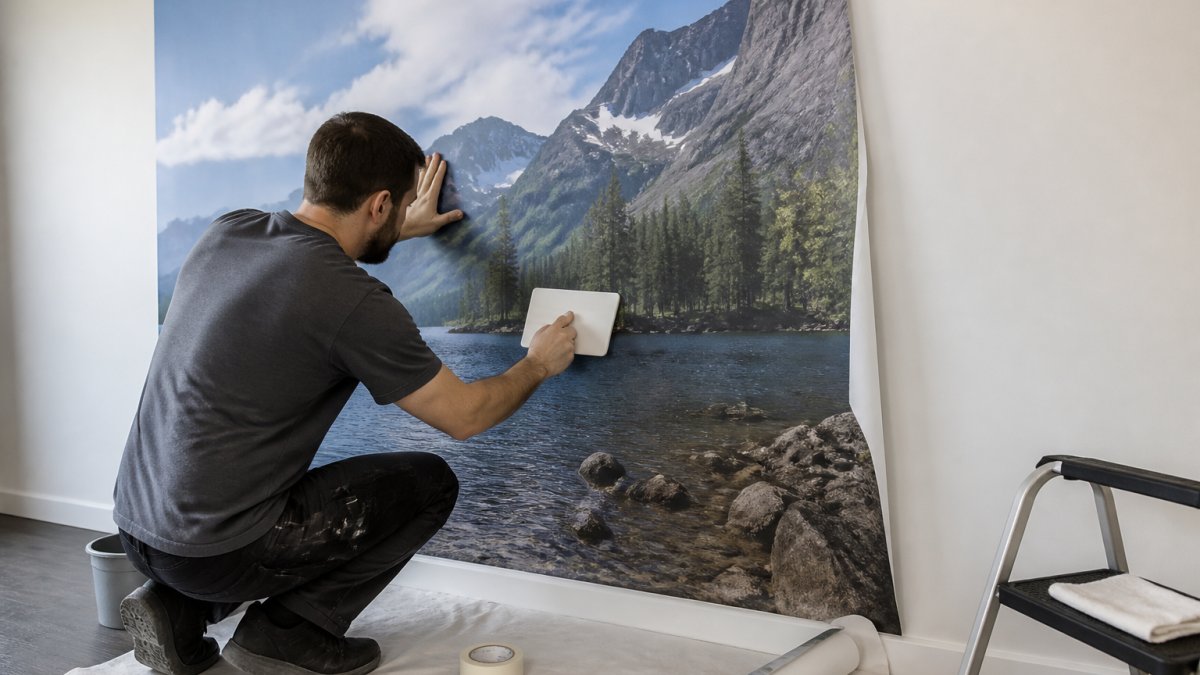
Surface Preparation and Alignment
Clean your wall thoroughly with a damp cloth and let it dry completely. For peel-and-stick murals, the wall must be smooth and free of texture; if textured, apply primer or sealant first.
Measure your wall and mark the starting point with a level to ensure a truly horizontal reference line, this prevents drifting during application.
Application Techniques and Common Mistakes
Start at the top and work downward, peeling back only a few inches of backing at a time to prevent the adhesive from sticking to itself.
Use a squeegee to smooth out air bubbles, working from the center outward. Small bubbles often disappear within 24 hours as the adhesive sets.
The most common mistake is rushing, which leads to wrinkles, bubbles, and misalignment. Take your time on the first section; subsequent sections become easier.
Murals wider than 48 inches arrive in panels with a half-inch overlap for seamless alignment; match the pattern carefully before pressing panels together.
Professional Grade Wall Mural Printing: What Sets Quality Apart
Professional-grade printing produces vivid, sharp imagery that lasts for years, depending on ink quality, resolution, substrate durability, and source image quality.
Understanding Resolution Requirements for Large-Scale Prints
Resolution is where most custom mural projects fail. Users upload low-resolution images expecting gallery-quality results, then discover pixelation. Understanding DPI (dots per inch) before uploading prevents costly mistakes.
For wall murals, 150 DPI minimum is standard; 300 DPI delivers sharper results. Smartphone cameras (3000-4000 pixels) work for murals up to 10-12 feet wide at 150 DPI. Larger installations require professional cameras, stock photography, or commissioned artwork.
Choosing the Right Source Image
Photographs with fine detail require higher resolution than abstract designs. Choose images with strong contrast and vibrant colors; use high-quality JPEGs or lossless formats like PNG. Vector graphics scale infinitely without quality loss, making them ideal for custom designs.
Let's Print Big accepts JPG, PNG, and PDF files up to 200 MB.
Leaves Design 065 Wall Mural Wallpaper →
Ink Quality and Color Accuracy
Let's Print Big uses water-resistant HP Latex inks that deliver vibrant color without harsh chemical odor and resist fading under moderate sunlight.
Color accuracy depends on monitor calibration and printer profiles. Order a sample (10" × 15") to verify color and sharpness under your room's lighting before committing to a full mural.
Substrate Impact on Print Appearance
Canvas-textured substrates soften fine detail but add artistic depth; smooth vinyl substrates render detail crisply and produce saturated colors. Use smooth substrates for fine detail, canvas texture for abstract designs or landscapes.
Durability, Adhesive Safety, and Long-Term Performance
Durability depends on ink quality, substrate material, and environmental conditions. Adhesive safety requires proper wall preparation to avoid paint damage or adhesive failure.
Ink Durability and UV Resistance
Water-resistant HP Latex inks resist fading, maintaining vibrant color.
For direct sunlight, use window treatments or UV-blocking film, choose cooler tones (blues, greens, purples), or select canvas-textured substrates to mask fading.
Quality vinyl substrates resist cracking, peeling, and yellowing in normal indoor conditions.
Adhesive Safety Across Different Wall Types
Peel-and-stick murals use removable adhesive, but success depends on your wall's surface type, paint finish, and age.
Testing Adhesion Before Full Installation
Test adhesion by ordering a sample (10" × 15") and applying it to an inconspicuous area. Wait 24-48 hours, then peel a corner. If it lifts easily without tearing, adhesion is adequate; if it tears the paint, prepare the wall first.
Removing Peel-and-Stick Murals Without Wall Damage
When you decide to remove the mural, proper technique prevents paint damage. Peel slowly and deliberately at a 45-degree angle, working from one corner across the entire mural. Rushing or pulling straight out risks gouging the paint or drywall.
Traditional Wallpaper Paste and VOC Considerations
Traditional non-pasted wallpaper requires adhesive application during installation. Most wallpaper pastes are cellulose or starch-based compounds with minimal volatile organic compounds (VOCs). These adhesives are considered safe for residential use and pose no significant health risk when applied according to manufacturer instructions.
Long-Term Performance in Challenging Environments
In bathrooms and kitchens with high humidity, water-resistant HP Latex inks and quality vinyl substrates perform reliably. The adhesive remains stable in humid conditions, though moisture can eventually compromise adhesion if the wall isn't properly sealed or if humidity exceeds 80% consistently.
Custom Photo Upload and Design Options
The ability to upload your own image is what truly sets custom wall murals apart from standard wallpaper. You're not limited to pre-designed patterns or manufacturer-selected imagery. Your personal photos, artwork, or commissioned designs become the mural itself.
Comparison of Wall Mural Solutions
| Feature | Canvas Textured Peel-and-Stick | Smooth Non-Pasted Wallpaper | Pre-Designed Standard Wallpaper |
|---|---|---|---|
| Custom Image Upload | Yes | Yes | No |
| Adhesive Type | Self-adhesive, repositionable | Requires paste application | Pre-pasted or non-pasted |
| Installation Difficulty | Beginner-friendly | Intermediate | Varies |
| Visual Finish | Artistic, textured | Refined, smooth | Limited to existing designs |
| Durability | 5-10+ years with quality inks | 5-10+ years with quality inks | Typically 3-7 years |
| Custom Sizing | Yes, any dimension | Yes, any dimension | Limited sizes |
| Cost | Moderate | Moderate | Budget-friendly |
The choice between these options depends on your installation comfort level, aesthetic preference, and budget. For most homeowners, canvas-textured peel-and-stick offers the best balance of ease, appearance, and customization. Let's Print Big offers both substrates, allowing you to test before committing to a full mural.
Frequently Asked Questions
What makes professional-grade wall mural printing different from standard wallpaper?
Professional-grade wall mural printing uses high-resolution HP Latex Inks and custom sizing to deliver vivid, water-resistant images that standard wallpaper cannot match. These murals are printed to order on your chosen substrate, either canvas textured peel-and-stick or traditional wallpaper, ensuring the final product matches your space exactly. The quality difference lies in color accuracy, durability, and the ability to scale designs to any wall size without pixelation.
Can I upload my own photos for custom peel and stick wall murals?
Yes. Custom wall mural providers allow you to upload your own high-resolution images and have them printed on peel-and-stick or traditional wallpaper substrates. Before committing to a full mural, consider ordering an affordable 10" x 15" sample to see how your image looks on the chosen material and confirm it works with your space. This prevents costly mistakes and ensures you're satisfied with the substrate texture and print quality.
How easy is it to install custom peel-and-stick wall murals yourself?
Peel-and-stick wall murals are designed for DIY installation. They arrive with installation instructions and require only basic surface preparation, cleaning and smoothing the wall, before application. The key is careful alignment before removing the backing. Test-align your mural first to avoid mistakes. Most homeowners complete installation without professional help, though patience during the application process helps prevent air bubbles and wrinkles.
Will custom wall murals last in high-heat or sunny climates?
Water-resistant HP Latex Inks used in professional-grade wall mural printing offer good durability in most residential conditions. However, extreme heat and direct sunlight can affect adhesive performance and color vibrancy over time. If you live in a very hot or sunny climate, ensure proper surface preparation and consider placing murals away from direct sunlight when possible.