
Peel and Stick Mural vs Traditional Wallpaper: 2026 Guide

Table of Contents
- Peel and Stick Mural vs Traditional Wallpaper: A Direct Comparison
- Material Composition: Self-Adhesive Backing vs Paste-the-Wall
- Cost Breakdown: Price Per Square Foot and Waste Factor
- How to Install Peel and Stick Wall Murals vs Traditional Wallpaper
- Best Surface Preparation for Wall Murals
- How Long Do Peel and Stick Murals Last?
- Removal Process and Wall Damage
- Health and VOC Emissions
- Which Wall Covering Fits Your Project?
- Frequently Asked Questions
Last Updated: September 23, 2026
Peel and Stick Mural vs Traditional Wallpaper: A Direct Comparison
A peel and stick mural is a printed wall covering with a self-adhesive backing that presses directly onto the wall, while traditional wallpaper requires a separate paste applied to either the wall or the paper itself. That single difference in how the product attaches drives almost every other trade-off you will weigh: installation time, surface preparation, removal, and long-term durability. This comparison from Let's Print Big breaks down both options side by side so you can pick the right one for your room before you order.
The stakes are higher than most buyers expect. Wall coverings are printed to order, and most suppliers will not accept returns for application errors or ordering mistakes, so a wrong choice is expensive. Below, we cover material composition, real cost per square foot, installation steps, surface prep, lifespan, removal, and indoor air quality.
Material Composition: Self-Adhesive Backing vs Paste-the-Wall
The core difference is the adhesive system. A peel and stick mural arrives with a removable, repositionable self-adhesive backing already applied by the printer. You peel the liner, press the panel to the wall, and smooth it flat. No paste, no water tray, no drying time.
Traditional wallpaper works differently. You either apply wallpaper paste to the wall and hang dry paper onto it, or you use a pre-pasted roll that you activate in water. Let's Print Big offers both substrates on its murals: a canvas-textured peel and stick option, and a smooth non-pasted traditional wallpaper that requires you to purchase paste separately.
Material also affects how a mural handles a wall. Peel and stick films are thin vinyl compositions with dimensional stability, meaning they resist stretching and shrinking after application. Non-woven and paper-backed traditional wallpapers are thicker, which hides minor wall imperfections better but shows seams more readily if pattern matching goes wrong.
Cost Breakdown: Price Per Square Foot and Waste Factor
Peel and stick murals typically cost more per square foot than basic traditional wallpaper, but the total project cost often lands closer than the sticker price suggests. The reason is waste factor.
Traditional wallpaper is sold in standard roll widths and pattern repeats.
| Cost Factor | Peel and Stick Mural | Traditional Wallpaper |
|---|---|---|
| Starting price | $7.95-$8.95 per sq ft | Varies by roll and pattern |
| Paste required | No | Yes, sold separately |
| Waste factor | Low, custom sized | Higher, roll-based |
| Tools needed | Squeegee, knife | Paste, brush, water tray, knife |
| Removal | Peel away | Scoring, steaming, stripping |
How to Install Peel and Stick Wall Murals vs Traditional Wallpaper
Peel and stick installation is a two-person job that most homeowners can finish in an afternoon. Traditional wallpaper takes longer because paste needs time to set and each strip must be booked and smoothed before the next goes up.
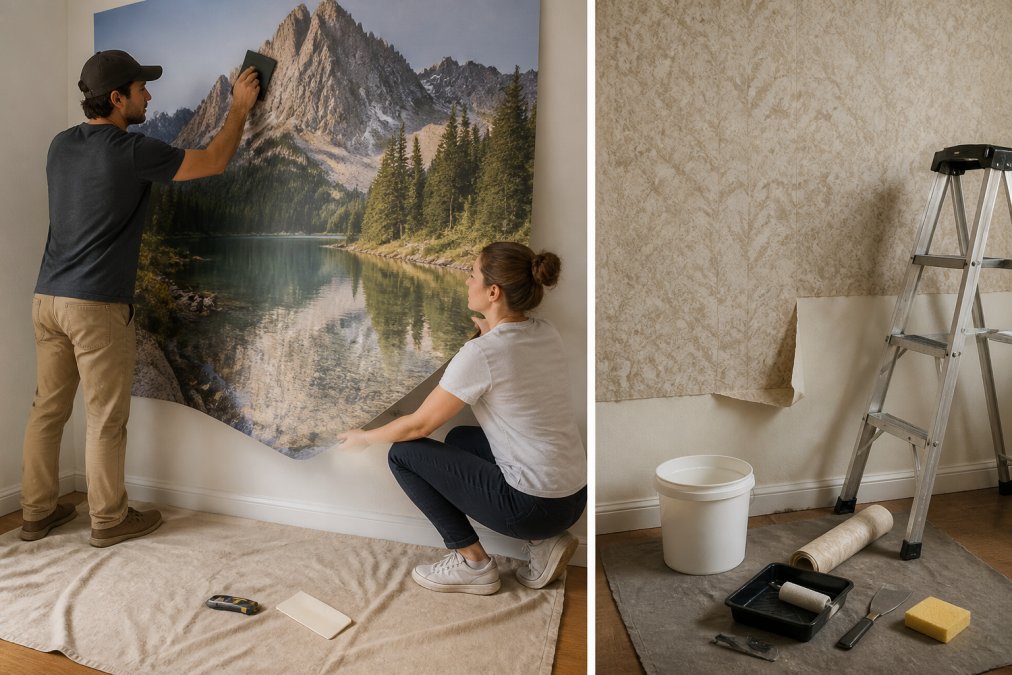
Tools and Timeline for Each Method
Peel and stick mural:
- Measure the wall and confirm your mural dimensions
- Clean the wall and let it dry fully
- Test-align panels before removing any backing
- Peel the top few inches of backing and press the panel into place
- Work downward, smoothing with a felt squeegee as you go
- Trim excess at the ceiling, floor, and corners with a utility knife
- Repeat for each panel, overlapping by the printed margin
Traditional wallpaper:
- Measure and cut strips, allowing for pattern repeat
- Apply paste to the wall or activate pre-pasted paper
- Book the strip and let it rest
- Hang the first strip on a plumb line
- Smooth out air and work toward the edges
- Trim and repeat, matching the pattern at each seam
Best Surface Preparation for Wall Murals
Surface preparation decides whether either product stays put. The best surface preparation for wall murals is a clean, dry, smooth wall with a cured coat of primer, free of dust, grease, and loose paint.
Leaves Design 065 Wall Mural Wallpaper →
Primer Application and Substrate Compatibility
Substrate compatibility matters more than most guides admit. Freshly painted drywall needs to cure before anything goes on it, because paint that is still off-gassing can trap moisture under the covering and weaken adhesion.
- Painted drywall: prime with a wallcovering-specific primer first
- Bare drywall: seal with primer to stop the paper from absorbing adhesive
- Glossy or semigloss paint: sand lightly to give the adhesive something to grip
- Textured walls: skim coat or accept that seams and bubbles will show
- Brick or cinder block: not suitable without a smoothing substrate
How Long Do Peel and Stick Murals Last?
Peel and stick murals typically last three to five years in a normal interior room, and traditional wallpaper often lasts longer because paste forms a more permanent bond. How long do peel and stick murals last in practice depends heavily on the room.
Durability Factors: Moisture, Sunlight, and High-Traffic Areas
Moisture resistance varies by substrate and by how well the edges are sealed. Bathrooms and kitchens are the hardest rooms for any wall covering because steam and splashes attack the seams first.
- Bathrooms and kitchens: use peel and stick with caution, seal edges, and keep the mural off direct splash zones
- Sunny rooms: prolonged direct sunlight fades ink over time, so expect color shift in south-facing rooms
- High-traffic areas: hallways and stairwells catch shoulders and furniture, which lifts edges
- Climate extremes: in hot, dry regions, adhesive can soften and release at the edges
Removal Process and Wall Damage
Removal is where peel and stick wins decisively. You lift a corner, pull the panel away at a low angle, and most of the adhesive comes with it. Traditional wallpaper removal is a project of its own: score the paper, apply a stripping solution or steam, scrape the backing off, then wash residual paste from the wall.
Health and VOC Emissions
VOC emissions are lower with peel and stick in most cases, because there is no wet paste curing in the room. Traditional wallpaper paste and primers are the main sources of volatile organic compounds in a wallpaper project, and they off-gas for days after installation.
Which Wall Covering Fits Your Project?
Pick peel and stick if you rent, if you want the project done in an afternoon, or if removal without wall damage matters. Pick traditional wallpaper if you want maximum lifespan, you are covering a textured wall, or the installation is permanent.
| Your Situation | Best Choice | Why |
|---|---|---|
| Renting or may move soon | Peel and stick mural | Clean removal, no paste residue |
| Textured or imperfect walls | Traditional wallpaper | Paste bridges light texture |
| Bathroom or kitchen | Either, with sealed edges | Moisture is the real enemy |
| Long-term permanent install | Traditional wallpaper | Stronger, longer-lasting bond |
| Custom-sized feature wall | Peel and stick mural | Printed to your exact dimensions |
| Tight budget, standard wall | Traditional wallpaper | Lower material cost per roll |
Frequently Asked Questions
Is peel and stick wallpaper as good as traditional wallpaper?
It depends on your priorities. Peel and stick mural options offer faster installation and easier removal, which suits renters and DIY projects. Traditional wallpaper with paste-the-wall application typically delivers longer lifespan and better performance in high-humidity areas. For a bedroom accent wall or office, peel and stick works well. For bathrooms or kitchens with constant moisture, traditional wallpaper with proper primer application holds up better over time.
What is the downside to peel and stick wallpaper?
The main downsides include potential adhesive residue upon removal if the wall was not properly primed, limited repositionability after the adhesive fully bonds, and reduced performance in high-humidity rooms. Substrate texture also matters: rough or unclean walls prevent proper surface adhesion, leading to peeling edges. Using a smoothing tool during installation and testing alignment before removing the backer helps avoid bubbles and misaligned seams.
Does peel and stick wallpaper damage drywall upon removal?
It can if the drywall was not prepared correctly. Primer application creates a barrier between the adhesive and the drywall surface, which protects drywall integrity during removal. Without primer, the self-adhesive backing can pull away paint or paper facing. For best results, apply a quality primer, let it cure fully, then install. When removing, peel slowly at a low angle to minimize stress on the wall surface.
Which wallpaper type is better for high-humidity areas like bathrooms?
Traditional wallpaper with paste-the-wall application generally performs better in bathrooms and kitchens because the adhesive cures into the wall surface and resists moisture lift. Peel and stick mural products can work in bathrooms if the wall is primed, the room has adequate ventilation, and the mural does not sit directly in splash zones. For powder rooms or low-moisture areas, peel and stick is a practical choice. For full bathrooms with showers, traditional wallpaper is the safer bet.
How do installation processes differ between murals and traditional wallpaper?
Peel and stick murals arrive with self-adhesive backing. You measure, test align, then peel and press panel by panel using a smoothing tool. No paste, no water tray, no drying time. Traditional wallpaper requires wall preparation, primer application, wallpaper paste, and booking time for the paper to relax before hanging. Pattern repeat and seam alignment demand more precision with traditional wallpaper, and you need a utility knife for trimming. Peel and stick is faster; traditional gives more forgiveness for repositioning during the hang.