
Printmoz vs Fastdecals: Vehicle Wraps Compared

Table of Contents
- Printmoz vs Fastdecals: Quick Comparison
- Vehicle Wraps vs Decals: Understanding the Core Difference
- Material and Vinyl Types: Air Release Vinyl for Vehicle Wraps
- How to Install Vehicle Decals: Printmoz and Fastdecals Approaches
-
Custom Truck Decals: Design, Ordering, and Specifications
- Vinyl type: calendared, cast, and air-release
- Adhesive: permanent vs. removable
- Laminate: gloss, matte, and why it matters
- Print method: solvent, eco-solvent, UV, and latex
- Artwork specs that prevent reprints
- Proofing and production timeline
- Shipping, warranties, and support
- Common ordering mistakes
- Removal, Paint Protection, and Long-Term Maintenance
- Which Vendor Should You Choose?
- Conclusion
- Frequently Asked Questions
Last Updated: October 13, 2026
Printmoz vs Fastdecals: Quick Comparison
Most pages ranking for Printmoz vs Fastdecals for vehicle wraps decals never actually compare the two vendors. This section does, flagging what to confirm by email before you pay, since both stores change product lines, pricing, and turnaround without notice.
What each vendor actually sells
Printmoz is a print-on-demand shop that expanded into vinyl graphics.
Fastdecals is a decal and graphics specialist with a deeper vehicle-oriented catalog: pre-designed and custom decals, racing stripes, window graphics, and larger printed panels.
Neither vendor is a wrap shop with a 3M or Avery-certified installer network. Both sell printed vinyl you (or a local installer) apply yourself.
Product range at a glance
| Factor | Printmoz | Fastdecals |
|---|---|---|
| Primary focus | Print-on-demand custom printing, including vinyl decals | Vehicle decals, graphics, and printed vinyl panels |
| Typical order size | Small to medium runs, single custom pieces | Single decals up to multi-panel graphic kits |
| Full color-change wraps | Not the core offering, confirm before ordering | Not the core offering, confirm before ordering |
| Pre-designed vehicle graphics | Limited | Extensive vehicle-specific library |
| Custom artwork upload | Yes | Yes |
| Best fit | Branded spot graphics, short-run decals | Vehicle-specific decals, racing stripes, larger printed panels |
Pricing: how to compare like-for-like
Neither vendor publishes a flat "wrap price." Price the same job at both stores:
- Same finished size. A 12" x 12" decal and a 24" x 24" decal are not the same product. Quote exact dimensions.
- Same material. Ask whether the quote is calendared, cast, or air-release vinyl, cast and air-release cost more and behave differently on curves.
- Same laminate. Unlaminated vinyl is cheaper and fails faster outdoors. Confirm which is in the quote.
- Same quantity. Per-unit price drops fast with quantity; a single decal and a run of 50 are different tiers.
- Shipping and tax. Add these before comparing totals, a cheaper sticker with $12 shipping can lose to a slightly higher one with free shipping.
A common pattern: Fastdecals wins on pre-designed, vehicle-specific graphics, and Printmoz wins on one-off custom pieces where you supply the file. Run your actual job through both carts before deciding.
Ordering process and artwork requirements
Both stores accept uploaded artwork, but the details are where orders go wrong.
- File formats. PDF and AI are safest for vector; high-resolution PNG or JPG works for raster.
- Resolution. Target 300 DPI at final print size, a file that looks sharp on screen can print soft when stretched.
- Color mode. Design in CMYK, not RGB, if print color matching matters.
Shipping, returns, warranties, and support
These factors decide total risk, not just total price.
- Production time vs. shipping time. Two different clocks: 3-day production plus 5-day shipping is an 8-day wait. Ask for both numbers.
- Shipping method and tracking. Confirm the carrier and whether tracking is included. Standard ground shipping in the continental U.S. is the usual default; expedited costs more.
- Return policy. Custom-printed items are frequently non-returnable unless the vendor erred. Read the policy before uploading artwork.
How to decide
- Choose Fastdecals for a vehicle-specific pre-designed graphic, racing stripe kit, or larger printed panel you'd rather start from a template.
- Choose Printmoz if you have your own artwork and want a short run of custom printed decals or spot graphics.
- Choose neither for a full color-change wrap, that job belongs with a wrap installer who stocks cast film and stands behind the installation.
Run the same job through both carts, screenshot the totals including shipping, and compare material and laminate line items side by side. That five-minute exercise tells you more than any review.
Vehicle Wraps vs Decals: Understanding the Core Difference
The terms "vehicle wrap" and "vehicle decal" are often used interchangeably, but they describe different products.
Coverage and Application
A vehicle wrap typically covers 50% or more of your vehicle's painted surface; full wraps cover the entire exterior, and partial wraps cover sections like side panels or the truck bed. A vehicle decal is a smaller graphic applied to a specific area, ideal for logos, text, or branded imagery on doors, windows, or truck beds.
Durability and Lifespan
Vehicle wraps made from quality air-release vinyl typically last 3-5 years with proper maintenance; decals often last 2-4 years, depending on sun exposure and climate.
Air-release vinyl, which most professional vendors use, includes tiny air channels that let bubbles escape during installation, producing a cleaner finish. Standard vinyl traps air, causing visible bubbles and wrinkles.
Material and Vinyl Types: Air Release Vinyl for Vehicle Wraps
Air-release vinyl features microscopic channels that let trapped air escape as you apply the graphic.
Most quality vendors, including those offering vehicle wraps decals through Printmoz and Fastdecals, use air-release vinyl.
Lamination also matters. A protective laminate layer shields graphics from UV rays, dirt, and minor scratches, and laminated graphics last longer and hold color vibrancy better.
How to Install Vehicle Decals: Printmoz and Fastdecals Approaches
Both vendors provide installation guidance, but the process is similar either way. Success depends on preparation, technique, and patience.
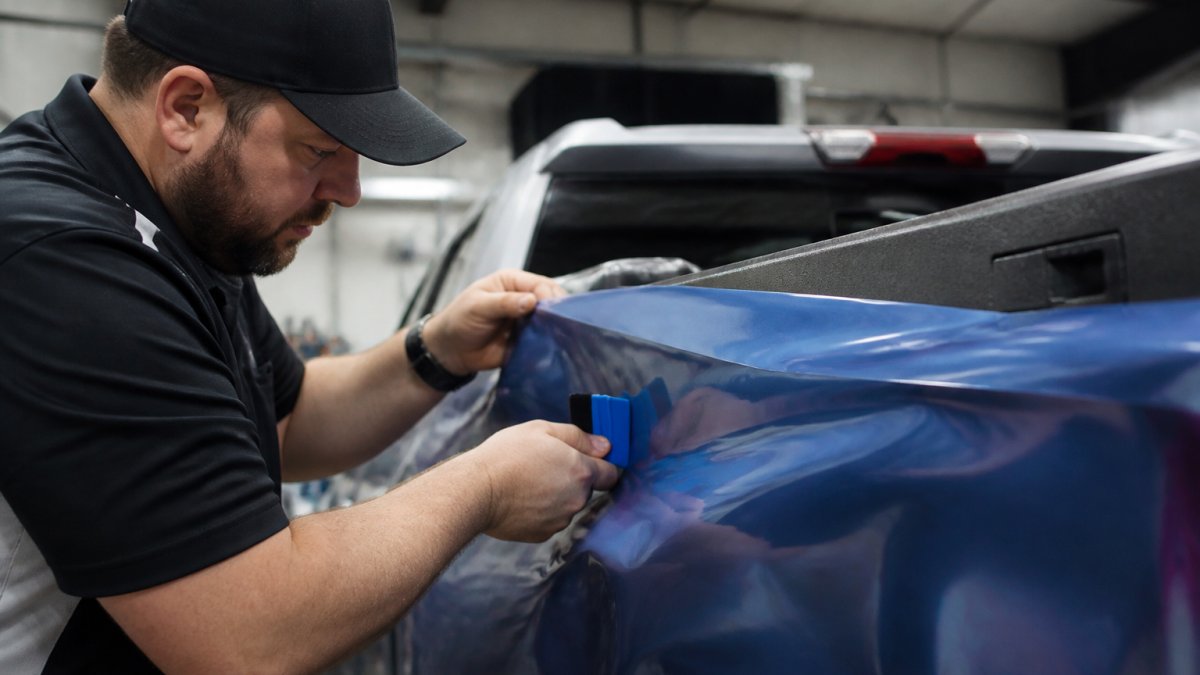
Surface Preparation and Application Steps
Start with a clean surface: wash with soap and water and dry completely, since dirt, dust, or residue prevents adhesion.
Measure twice. Mark the center of your graphics and the center of your installation area to prevent off-center placement.
Apply slowly with a squeegee or hard plastic card, working from the center outward to push air toward the edges.
Common Installation Mistakes to Avoid
The biggest mistake is skipping surface prep, a dusty surface causes adhesion failure within weeks, and even a seemingly clean truck bed may have invisible residue.
Applying vinyl in cold temperatures is another common error.
Over-stretching causes vinyl to shrink back, creating gaps and peeling edges. Apply firm, even pressure rather than aggressive pulling.
Custom Truck Decals: Design, Ordering, and Specifications
The difference between a decal that looks right for five years and one that peels in six months usually comes down to four specs chosen at checkout: vinyl type, laminate, adhesive, and print method.
Vinyl type: calendared, cast, and air-release
Vinyl falls into two manufacturing families, and the family determines how the film behaves on curves and how long it lasts.
- Calendared vinyl is made by squeezing heated PVC between rollers. It's cheaper and works on flat or gently curved surfaces like a truck-bed panel, but shrinks slightly over time, exposing adhesive edges outdoors.
- Cast vinyl is poured as a liquid onto a liner and cured. It's thinner, conforms to compound curves (mirrors, bumpers, rivets) without heat, and resists shrinking far better. It costs more and is the standard for anything approaching a wrap.
- Air-release vinyl is a feature, not a family, it can be calendared or cast. Microscopic channels in the adhesive let trapped air escape, so DIY installers get fewer bubbles. Both Printmoz and Fastdecals offer it on many products; confirm it's listed on the specific SKU.
Adhesive: permanent vs. removable
Adhesive choice is separate from vinyl choice, and it's the spec most buyers forget to check.
- Permanent adhesive is the default for vehicle graphics, it bonds aggressively and stays put for the life of the graphic. Removal requires heat and patience.
- Removable adhesive peels cleanly for a defined window (often up to a year or two). It's right for seasonal promotions, event graphics, or anything you plan to strip.
For a leased vehicle or one you plan to sell, ask which adhesive is on the SKU. The wrong one can mean hours of cleanup later.
Laminate: gloss, matte, and why it matters
Lamination is a clear protective film over the printed vinyl, the biggest durability upgrade you can buy, and it changes the look.
- Gloss laminate preserves color vibrancy and adds a slight shine; the most common choice for commercial graphics.
- Matte laminate kills reflections for a flatter, more premium look, but shows fingerprints and smudges more.
- No laminate is cheaper and fades faster, fine for short-term indoor use, a poor choice for a truck that lives outside.
Lamination also protects against UV fade, car-wash abrasion, and road-debris scratches. If a quote doesn't mention laminate, ask whether it's included or an add-on, the answer changes the real price.
Print method: solvent, eco-solvent, UV, and latex
Most custom vehicle decals are printed with one of these methods:
- Eco-solvent / solvent, the workhorse for outdoor vinyl; good color and durability when laminated.
- UV-curable, fast-curing, sharp detail, common on rigid substrates and some vinyl.
- Latex, water-based, low odor, increasingly common for vehicle graphics; good outdoor performance when laminated.
The method matters less than the combination of vinyl + laminate + ink. Cast vinyl with quality laminate and eco-solvent ink outlasts calendared vinyl with no laminate every time.
Artwork specs that prevent reprints
- Format: vector (PDF, AI, EPS) is safest; raster (PNG, JPG) works if high enough resolution.
- Resolution: 300 DPI at final print size, a 150 DPI file blown up to a 24" decal looks soft.
- Color mode: CMYK, not RGB.
Proofing and production timeline
- Digital proof: free at most vendors and worth requesting on every custom order. Check spelling, phone numbers, and logo proportions, not just color.
- Physical proof or sample: worth the cost on large or color-critical jobs; a printed sample on your actual vinyl tells you more than any on-screen proof.
- Production time: typically a few business days after proof approval, but it varies by vendor and season. Ask for the current number.
Shipping, warranties, and support
- Shipping: standard ground shipping in the continental U.S. is the usual default; expedited options cost more. Confirm tracking is included.
- Warranties: most vinyl vendors warrant manufacturing defects (adhesive failure, print defects) but not installation errors or normal UV fade. Read the terms before you order, especially on large jobs.
- Returns: custom-printed items are frequently non-returnable unless the vendor made an error. Confirm the policy before you upload artwork.
Common ordering mistakes
- Ordering calendared vinyl for a curved surface.
- Skipping laminate to save a few dollars, then replacing the graphic within a year.
- Uploading RGB artwork and being surprised by the printed color.
- Forgetting to confirm bleed and getting white edges after trimming.
- Not asking whether the quote includes laminate, shipping, or tax.
- Assuming "removable" when the SKU is permanent adhesive.
Get these six right and the vendor question matters much less, the spec sheet does most of the work.
Removal, Paint Protection, and Long-Term Maintenance
Removing vinyl graphics properly prevents paint damage; improper removal can strip clear coat or leave stubborn adhesive residue.
Heat makes removal easier.
Clean remaining adhesive with rubbing alcohol or adhesive remover, testing first on an inconspicuous area.
Quality vinyl and proper installation also protect the paint underneath, acting as a barrier against UV rays, minor scratches, and weather.
Which Vendor Should You Choose?
Both Printmoz and Fastdecals offer quality air-release vinyl and professional printing. Choose based on these factors:
- Customization complexity: For extensive custom design support, confirm the vendor offers design consultation or revision rounds before final printing.
- Timeline: Compare shipping times. Standard shipping typically takes 1-2 weeks; expedited costs more.
- Product type: Spot graphics and decals are easier to install than full wraps. If you're new to vinyl, start smaller to build confidence.
The real differentiator isn't the vendor, it's understanding your own needs. Match your product to your use case and any quality vendor will serve you well.
Conclusion
Choosing between vehicle wraps and decals from different vendors comes down to matching product type to your installation skill level and durability needs.
At Let's Print Big, we deliver professional-grade vinyl graphics with products that arrive weeded and masked for easy installation. Our video tutorials and installation guides help you avoid common mistakes, and our free shipping on qualifying orders removes barriers to getting started.
Frequently Asked Questions
What is the main difference between a vehicle wrap and a vehicle decal?
A vehicle wrap is a large sheet of printed vinyl that covers most or all of the vehicle's painted surface, typically requiring professional installation and offering full branding coverage. A vehicle decal is a smaller, pre-cut graphic applied to specific areas like doors, windows, or the truck bed. Wraps provide comprehensive advertising and protection; decals add accent graphics and custom messages. Decals are easier to install yourself, while wraps usually demand professional application for bubble-free results.
How long do vehicle decals and wraps last?
Quality vinyl decals and wraps typically last 3 to 7 years depending on climate, sun exposure, and maintenance. Air-release vinyl used in professional products resists fading and adhesive breakdown better in high-heat or UV-heavy environments. Regular cleaning and avoiding harsh chemicals extend lifespan. Vehicles in sunny climates may see faster color fade, while covered storage preserves graphics longer. Both Printmoz and Fastdecals use durable materials, but local conditions and care routines significantly affect real-world durability.
Can I install a vehicle decal myself, or do I need professional help?
Small to medium decals can be installed by most people following step-by-step instructions, especially when products arrive weeded and masked for easy application. Larger wraps covering significant panel areas are harder to apply without professional experience because alignment, air bubble removal, and seam placement demand precision. If you're confident with your hands and follow video tutorials carefully, decals are manageable DIY projects. For full vehicle wraps or complex multi-panel graphics, professional installation reduces the risk of wrinkles, misalignment, and adhesive failure.
Will a vinyl decal or wrap damage my truck's paint when removed?
High-quality vinyl decals and wraps designed for vehicle graphics are engineered to release cleanly without damaging factory paint when removed correctly. Air-release vinyl used by reputable vendors like Printmoz and Fastdecals adheres firmly during use but peels away without leaving residue if removal is done slowly and at a low angle. Damage occurs only when decals are force-removed, left on for many years in extreme heat, or applied to compromised or freshly painted surfaces. Proper surface preparation before installation also protects your paint.