
Are Heavy Duty Vinyl Decals for Cars Worth It?

Last Updated: November 4, 2026
Quick Summary
Heavy duty vinyl decals for cars are worth it when you choose cast vinyl with a UV-resistant laminate and apply it to a sound, fully cured finish. They hold color and adhesion through sun, rain, road salt and repeated washing, and quality films are paint-safe when removed correctly.
- Cast vinyl generally handles curves and recesses better, while calendared film suits flat panels.
- Wash the panel with mild soap, wipe with isopropyl alcohol, and let it dry fully before applying.
- Applying a large decal in direct sun or on a hot panel can make the film stretch and grab too fast.
- Allow recently repainted panels to fully cure before applying a decal to reduce paint pull risk.
- Keep pressure washer nozzles at a distance and angled away from decal seams to avoid lifting.
Table of Contents
- What Heavy Duty Vinyl Decals for Cars Actually Deliver
- The Best Vinyl Material for Automotive Decals
- How to Apply Large Vinyl Decals to Cars Without Bubbles
- Paint-Safe or Paint-Risky? What Decals Do to Your Finish
- DIY vs. Professional Installation: Cost and Risk Compared
- Keeping Heavy Duty Vinyl Decals Clean Through Sun, Salt and Winter
- What the Law Says About Vehicle Decals and Window Tint
- Pick Your Aventador Decal and Order With Confidence
- Frequently Asked Questions
What Heavy Duty Vinyl Decals for Cars Actually Deliver
Heavy duty vinyl decals for cars are pressure-sensitive films built to hold color and adhesion through sun, rain, road salt and repeated washing.
Material and surface preparation both affect how long a decal stays put, so proper prep matters as much as the film itself.
Below, we break down which vinyl to buy, how to install it without bubbles, what it does to your paint, and the rules that apply to vehicle graphics.
The Best Vinyl Material for Automotive Decals
Cast vinyl with a laminated overcoat is a common choice for anything that faces the weather. Calendared vinyl is often used for flat, indoor, or short-term applications. The difference comes down to how the film is made and how it behaves when it stretches over curves.
Automotive-grade films are designed to conform to compound curves like fenders and mirrors. Cast film is generally more dimensionally stable on curves, while calendared film can have memory that makes it want to return to flat, which can lead to edge lift.
Cast vs. Calendared Vinyl: What the Numbers Say
Cast vinyl is made by casting a liquid onto a liner, which gives it a more dimensionally stable structure. Calendared vinyl is pressed through rollers, which leaves stress in the film. Cast film generally handles curves and recesses better, while calendared film suits flat panels.
When choosing film, match it to the surface. Flat indoor surfaces can use calendared film, while curved outdoor surfaces typically call for cast film.
When Laminate and Clear Coat Matter
Laminate is a thin protective layer applied over the printed film that can add UV resistance and scratch protection. On outdoor decals it helps colors hold up better in sun.
Clear coat refers to the vehicle's own topcoat, not the decal. A decal over healthy clear coat protects that layer from sun and minor abrasion; over failing clear coat it can trap moisture and accelerate peeling. Test an inconspicuous spot first.
How to Apply Large Vinyl Decals to Cars Without Bubbles
Bubble-free installation generally depends on a clean surface, a wet or dry method matched to the film, and a squeegee used in overlapping strokes. Rushing any of these steps can lead to wrinkles.
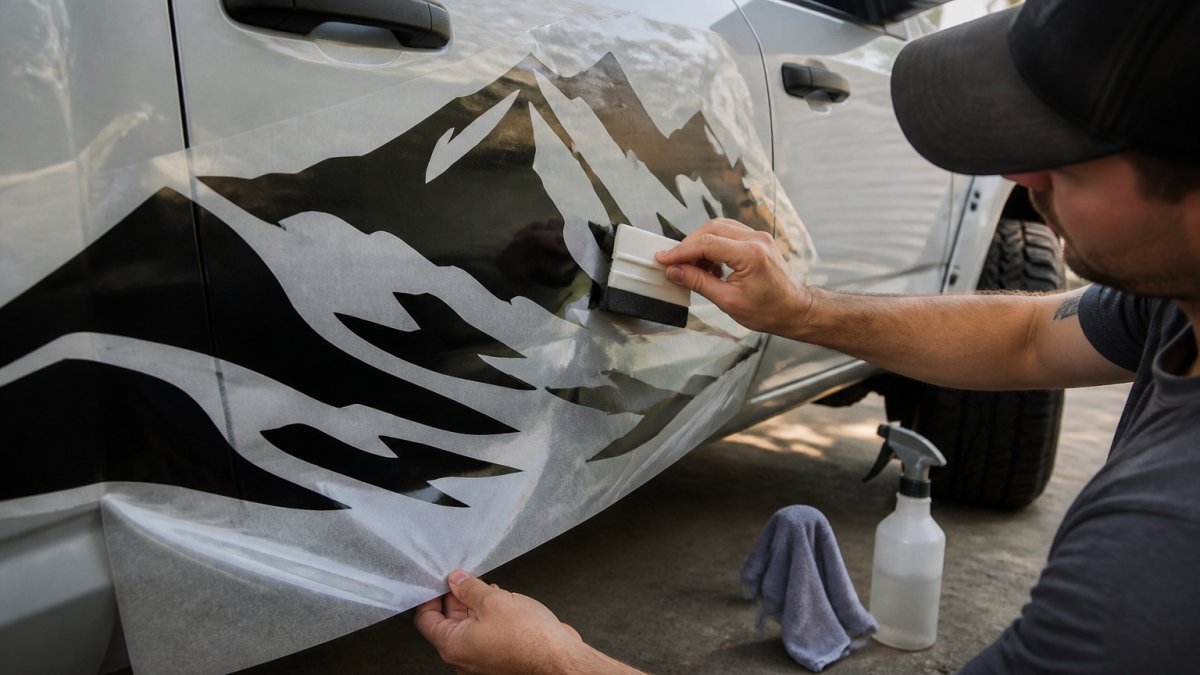
- Wash the panel with mild soap, then wipe it down with isopropyl alcohol and let it dry fully.
- Measure and mark a level baseline with painter's tape so the decal sits straight.
- For wet application, mist the surface with a few drops of dish soap in water so the film can be repositioned.
- Peel the backing, keeping the transfer tape attached, and set the decal on the baseline.
- Anchor the top edge, then squeegee from the center outward in overlapping strokes.
- Work out trapped solution and air toward the edges, lifting and re-squeegeeing stubborn spots.
- Remove the transfer tape slowly at a low angle, then re-squeegee the film.
- Trim any overhang and check edges with your thumb.
Watch out: applying a large decal in direct sun or on a hot panel can make the film stretch and grab too fast. Working in shade and letting the surface cool helps.
Before you start, read our guide on how to clean vehicle surfaces before decals so the adhesive has a clean, dry surface to bond to.
Paint-Safe or Paint-Risky? What Decals Do to Your Finish
Quality vinyl decals are paint-safe when applied to a sound, fully cured finish and removed correctly. The risk comes from fresh paint that has not cured, a failing clear coat underneath, and removal done with heat or tools that damage the surface. "Paint-safe" is a function of adhesive chemistry, film type, sun exposure, and time.
How Adhesive Chemistry Interacts With Clear Coat
Automotive decals commonly use one of several adhesive families, each of which releases differently.
Paint damage associated with decals usually comes from removal technique, such as pulling too fast, using a razor, or applying too much heat, or from trapping moisture against a failing clear coat.
The Three-to-Five-Year Outlook by Surface Type
| Surface condition | 3-5 year outlook with cast film + acrylic adhesive | Main risk |
|---|---|---|
| Healthy factory clear coat | Low risk; clean release with heat and slow pull | Faint adhesive outline that polishes out |
| Repainted panel (under 30 days cure) | High risk; solvent can soften fresh paint | Lifting paint on removal |
| Failing or peeling clear coat | High risk; moisture trapped under film | Accelerated clear-coat delamination |
| Single-stage paint (older vehicles) | Moderate risk; adhesive bonds to pigment | Pigment pull on removal |
| Matte or satin factory finish | Moderate risk; heat and adhesive can gloss the surface | Shiny ghost outline |
Fresh paint releases solvents for a period of time, and a decal applied too soon can trap them, which may cause bubbles or adhesion problems. A lifted edge can let water get under the film, so keeping edges sealed is important.
How to Test Before You Commit
Before applying a large decal to a repainted or older panel, test an inconspicuous spot, such as inside a door jamb or under the trunk lid, to check how the surface responds.
Watch out: applying a decal over a recently repainted panel can increase the risk of paint pull on removal, so allow the paint to fully cure first.
If you are worried about removal, our article on whether vinyl decals are easy to remove later walks through the safe method step by step.
Lamborghini Aventador Arancio Orange – Supercar Contour Cut Decal →
DIY vs. Professional Installation: Cost and Risk Compared
DIY installation avoids labor charges and can work well on flat panels and small to medium decals. Professional installation may be a better fit for full wraps and complex curves, where a professional's experience can help avoid stretching the print.
| Factor | DIY Installation | Professional Installation |
|---|---|---|
| Cost | Film only | Film plus labor |
| Best for | Flat panels, small decals | Full wraps, complex curves |
| Bubble risk | Higher on large pieces | Lower |
| Time | An afternoon | Scheduled appointment |
| Error recovery | Limited | Handled by installer |
A middle path can work well: order a decal that arrives weeded and masked, follow an installation video, and practice placement with tape before committing.
Keeping Heavy Duty Vinyl Decals Clean Through Sun, Salt and Winter
Routine care is what separates a decal that looks new after several years from one that fades and lifts. Wash with mild soap and water, rinse thoroughly, and skip abrasive pads and harsh solvents.
Sun exposure is a major factor in fading. For a deeper look, see our guide on preventing vinyl graphics from fading in sun.
Watch out: pressure washers held close to decal edges can lift the film, so keep the nozzle at a distance and angle it away from seams.
What the Law Says About Vehicle Decals and Window Tint
Vehicle decals are often permitted, but window tint and certain placements may be governed by state law, and commercial vehicles may have additional rules. Requirements vary by state, and federal rules may also apply to commercial vehicles.
The Three Layers of Rules That Apply
- State motor vehicle statutes. Each state's DMV or motor vehicle agency sets window tint limits, typically expressed as visible light transmission (VLT) percentages for the windshield, front side windows, and rear windows. Many states also restrict decals that obstruct the driver's view or cover required equipment.
- State inspection and equipment standards. Even where tint is legal, a safety inspection can fail a vehicle if the tint or a decal placement violates equipment rules. Inspection manuals are usually published by the same state agency that handles registration.
- Federal rules for commercial vehicles. The Federal Motor Carrier Safety Administration (FMCSA) regulates commercial motor vehicles, and its standards address windshield and window obstructions for vehicles in interstate commerce. If you run fleet graphics on vehicles that cross state lines, both the FMCSA standards and state rules apply.
What Is Almost Always Prohibited
A few placement rules are near-universal across state codes:
- Do not obscure the license plate, including the state name and registration stickers.
- Do not cover headlights, taillights, turn signals, or reflectors.
- Do not obstruct the driver's view through the windshield or front side windows beyond your state's VLT limit.
- Do not cover required safety equipment or inspection stickers.
Windshield tint is the most restricted area. Most states limit or prohibit aftermarket tint on the windshield except for a narrow band at the top, and some allow medical exemptions with a physician's certification. Front side window limits vary widely. Rear windows are usually less restricted, but many states require dual side mirrors if the rear glass is heavily tinted.
Commercial and Fleet Graphics
Business lettering on a vehicle is generally treated differently from window tint. Most states do not require a permit for ordinary business lettering on body panels, but some municipalities require a permit for certain commercial signage or for vehicles used primarily as advertising.
A practical workflow: identify your state motor vehicle agency, pull its window tint statute and equipment inspection manual, and check the VLT limits for each window position. For fleet use, add the FMCSA standards.
Pick Your Aventador Decal and Order With Confidence
Ready to put a supercar silhouette on your garage wall, trailer, or shop display?
Choose the Lamborghini Aventador Arancio Orange decal for a bold classic look, or go stealthy with the Lamborghini Aventador Satin Black decal for a subtle finish.


Best for: garage walls, game rooms, workshops, enclosed trailers, and RVs.
Video tutorials are available with your order, and qualifying orders ship free. For outdoor use, the laminated vinyl option is built for compatible smooth exterior surfaces, and you should follow the surface prep steps above.
Frequently Asked Questions
What is the most durable vinyl for car decals?
Cast vinyl with a laminated overlaminate is a strong option for vehicle use. Cast film conforms to curves and rivets without lifting, and the laminate layer blocks UV light that fades ink. In Let's Print Big's outdoor option, ORAFOL ORAJET 3165RA print film is paired with ORAGUARD 210 overlaminate, a 4 mil film plus 2.5 mil protective layer built for smooth exterior surfaces like enclosed trailers and RVs. Calendared vinyl costs less and is generally less suited to curved panels.
How long do heavy duty vinyl decals for cars last?
Lifespan depends on film type, sun exposure and care. Heat, UV and repeated washing can all affect how long a decal lasts. Parking in shade and gentle washing can help, and checking edges periodically is a good habit.
Do heavy duty vinyl decals damage car paint?
Quality vinyl is paint-safe when the paint is fully cured and the surface is clean before installation. Fresh paint needs to outgas first, which is why the product guidance says to let new paint fully cure and test an inconspicuous area before applying. The real risk comes from cheap adhesive that leaves residue or from peeling a decal off dry.
Can you put heavy duty vinyl decals on car windows?
Yes, on glass the film bonds well and removes cleanly. Two things to watch: state law limits how much tint or obstruction you can add to windshields and front side windows, so check your state's rules before covering glass, and avoid placing decals over defroster lines or antennas. Clean the glass thoroughly and let it dry fully before application.
How do you clean heavy duty vinyl decals on a vehicle?
Hand-wash with pH-neutral car soap and a soft microfiber mitt, then rinse and dry. Skip the pressure washer at close range on decal edges, and never aim a wand directly at a seam.
Choosing the right heavy duty vinyl decals for cars starts with matching the film to the surface and taking prep seriously. Let's Print Big makes that easier with high-resolution graphics, decals that arrive weeded and masked, and step-by-step installation guidance. Browse our Aventador decal collection, pick your color and width, and get started with Let's Print Big today.
